Seberon “Boo” Litzenburger Nature Preserve / Jeff Moyer
THE DRAGONFLY FUND GIFT
By Liesel Litzenburger Meijer
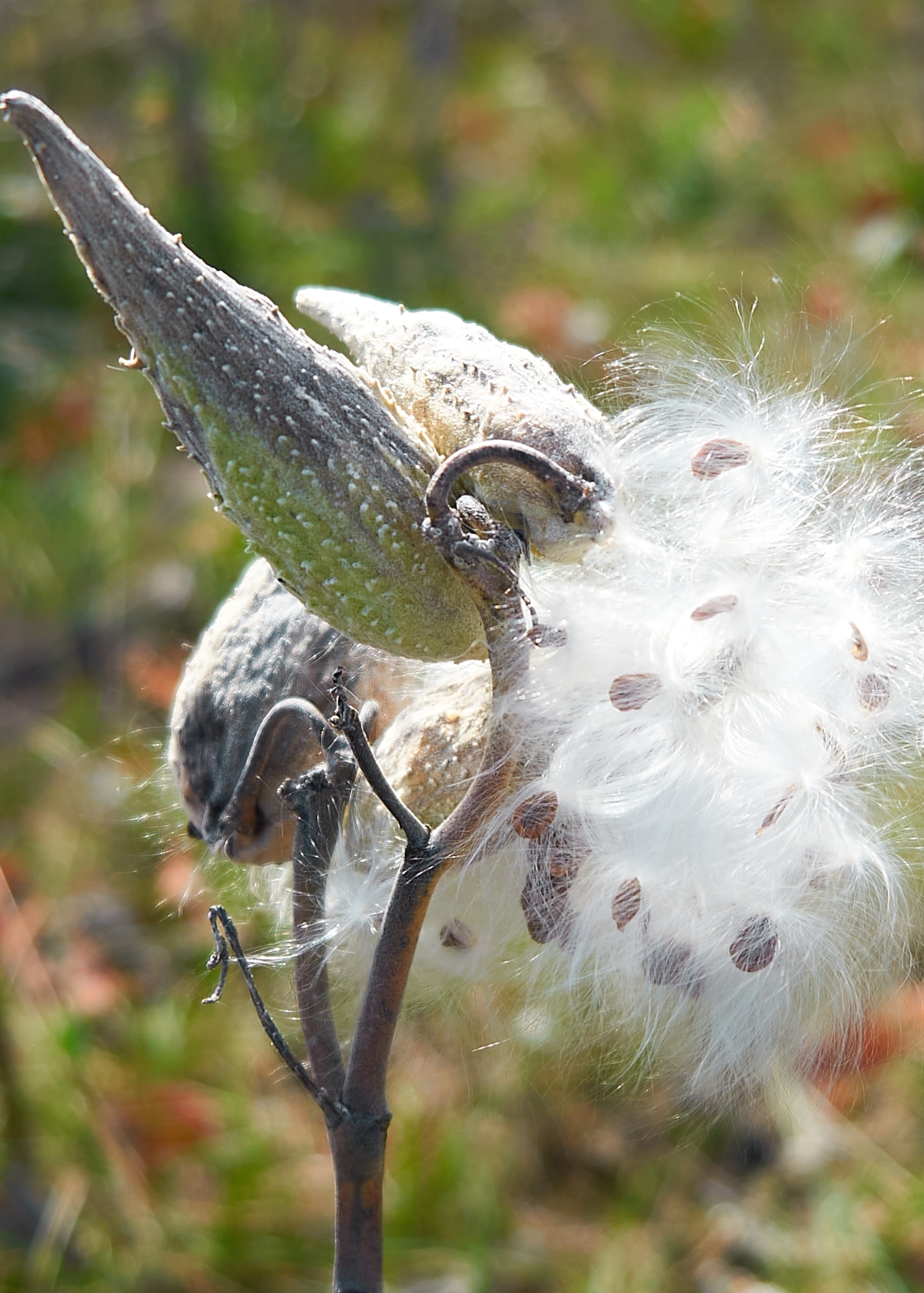
Two million pounds. That was the weight of ripe milkweed pods requested for harvest by the U.S. government in 1942. The reason was simple: kapok, the cottony fiber typically used to fill life-preservers, a material cultivated in tropical regions of southeast Asia, had been cut off during the war, and a critical new material needed to be found to provide life-saving vests for the airmen, sailors, and soldiers.
The search began, tests were run, scientists scrambled. A Chicago physician and part-time inventor, Dr. Boris Berkman, stepped forward with a handful of milkweed pod fluff. He claimed no less than twenty prime uses for the milkweed pod and its silky floss, chiefly that it could keep a 150-pound human being comfortably afloat for more than 40 hours in open water. Now to harvest as much as possible as fast as possible; war was raging.
The place chosen as the epicenter for this life-saving mission was here, the milkweed-plentiful fields and rolling green hills along the shores of northern Lake Michigan. Emmet, Charlevoix and Mackinac Counties became the world’s resource, and a one-of-a-kind 50,000 square-foot processing facility was constructed on the site of a Petoskey lumber mill. The fairgrounds were used for drying the collected pods in huge burlap sacks and pod storage was set up in downtown buildings. Collection of the pods was key—and schoolchildren were enlisted as the principle harvesters since their small hands might best grasp the milkweed pods at the crucial stage of ripe yet unopened, full of fluff, but before fall rains had destroyed them or the sides had split open, the contents blown away forever by wind.
“Two bags save one life!” was the motto. A modest goal was set in Petoskey for the first day of collection in September of 1942. One thousand bags were collected. Later, Boyne Falls would set a goal of 3,000 bags, only to surpass it to harvest 5,000 bags. St. Ignace, Cross Village, Beaver Island, Harbor Springs; every town in our region delivered more than ever promised, more than ever hoped, the vast amount of the world’s supply. One little girl, age five, collected bag after bag in the fields above her family’s home on Walloon Lake. School was cancelled on the main collection days. She filled a sack as large as she was tall, bigger. Her father would come to find her and haul it away, only to begin again with a new sack to be filled. She lost count of how many sacks she filled, but she wanted to save as many lives as she could, to help, so on she went from plant to plant. She knew family members were serving in the war far away and the pods’ silky contents could do this—her cousin on a ship somewhere in the Pacific Ocean, people she would never know, all the other soldiers who would wear vests filled with what she held in her hands. The days were sunny, and nature surrounded her as she worked.
The little girl picking milkweed is my mother, Cameron Reycraft, and the lands on which she harvested the pods are now a Little Traverse Conservancy Preserve, protected forever. My mother’s life, the lives saved by her childhood harvest of fluff, one handful growing to thousands; entire towns coming together as our region of the world was singled out for its powerful natural state, for its wild places. It was chosen to preserve life itself because of all that nature provides for us and because of what nature can give to us, only here.
Nature does not let us down. Now it is our time to not let nature down, to be here now. We are tied to these lands, to each other and all that is intertwined, tethered and held by invisible threads; this is our time. I see my generation as the bridge between the past and the future, between our ancestors and our children and grandchildren who will inherit this place, these lands. What we do now determines what they will have in their lives. What we do now allows future generations to enjoy all the freedom and beauty we have had the joy of being surrounded by, even taken for granted, all of our lives. The earth, the sky, the huge freshwater lakes, the trees, deep forests, artesian waters, swamps full of wild orchids, animals, plants, birds and bugs; the myriad hidden and beautiful places no one has even seen. There is no place like this on Earth. This is our place and our time in it is right now.
These precious and unquantifiable gifts of our lands are what save us, just as they did when the world needed a magical plant that could keep human beings alive and afloat, literally. There seems no way to quantify or measure what this means to all of us. What does it weigh? What does it cost? Nothing and everything. Two million pounds. A handful of fluff.
When my father, Boo Litzenburger and the other six founders of the Little Traverse Conservancy set forth in their mission to preserve the natural world of our irreplaceable region, they first had to change their minds. That takes a certain inner strength, to be willing to be humble and honest enough to do the right thing at the right time, even if it is not easy nor one’s initial quest. For the founders, I believe that meant they had to both dig deeply within themselves, to care in essential ways to get the job done, and then stand up tall, to try to see far into the future so that others might carry on their work. While they initially formed to slow or even halt development of natural and wild places, they quickly shifted in intent when it was realized they would always be chasing after what was about to happen or what was already gone. Much better to be out in front, to leap ahead and lead in preservation and conservation. They looked around and identified places to preserve, lands to save—to act rather than to react. Wild places are wild places only once. We cannot create them, and we cannot unring the bell when they are gone. The founders of LTC knew this and they acted accordingly. With the passing of the last of the founders, that duty is now ours and it rests upon our shoulders. We carry this with us every day we spend in this part of the world. I picture all of us walking forward into the future with this dream. To me, it is my deeply held belief that it is the least I can do. The region’s economy, its very survival in many ways depends upon this form of conservation. How can we best help everyone is something I often ask. The answer lies in what we do right now, for the greater good.
Now, some fifty years plus after the founding of LTC, here we are. And we are here. If you had asked my late father, he would have told you instantly that we are in the most beautiful place in the world. If you ask my mother, we are at the center of a region of unparalleled importance and beauty, of value. We save lives here, and I mean that sincerely. Nature is healing, a balm in hard times, a calm, a form of peace. It is here for us, every day, and everyone who comes here for a day, or forever, experiences this.
I have never taken a walk or a hike, spent time with family or friends outside, even five minutes of quiet with a tree or staring at the lake and come away lesser for it. I have never spent time outside and come away saying, “Well, that sure was a waste of time!” Of course, quite the opposite. It is so often our very best time. Spending time outside in the beauty and nature in Northern Michigan. That is all I need to say when I think of what I want to leave for the generations to come. We have our families, our friends, those we love, good health, important work to do, ways to help others. Beyond this, we have this place. If someone asks you to pause even for a few seconds to think of what is most important for you to leave for those to come, would you answer with all that surrounds us in this place we call home? Our beautiful corner of the world. I would and I do. I hope this offering can ripple outward and grow and grow. I hope you might be moved to join me in our walk forward into the next fifty years and beyond. I hope we surpass 5,000 sackfuls of dreams. One handful of fluff. Many handfuls of fluff. Two million pounds. Lifetimes in the making. This place, this life, right now. This is our time. We are here.

Landmark Gifts Empowering Others
A historic announcement from Executive Director Kieran Fleming
Every year, our Annual Meeting is a significant moment for Little Traverse Conservancy. We get to share the incredible work and accomplishments of this thriving organization, thanks to you. And, now one year into our five-year strategic plan, we are starting to see some of our ambitious goals come into focus. There were many great things shared. Our staff, volunteers, and members accomplished a lot. You should be proud of where you have brought our mission.
One announcement stands out as transformational. We have had significant events before—our founding being the first, and the Offield Challenge in 2001-2011 certainly impacted LTC’s trajectory exponentially.
At this year’s Annual Meeting, I was able to announce a monumental commitment to LTC from Liesel Litzenburger Meijer.
This did not happen on a whim. Liesel has been with us from the very beginning. You see, her dad was Seberon “Boo” Litzenburger, one of our seven founders. She was literally playing around in the rooms where LTC went from an undefined concept into the fully realized institution we are today. Her mom can recount the stories of those men conjuring up the notion of a “land trust”. I love the intergenerational involvement in our organization—Sue Stewart (daughter of Dave Irish) is currently our Vice Chair; Laura Tanton (John Tanton’s daughter) serves on our Stewardship Committee; Gregg Garver (John Fisher’s son in-law) is on our Board and is a past Treasurer and Board Chair; and Joel Moore (Ed Koza’s son-in-law) is a past Board Chair and has been our general counsel for decades.
From my seat, the notion of one of our Founders helping to launch LTC into existence, and for his daughter to now help propel LTC and our mission to this significant next level not only tells an incredible story of success, but it beautifully, and in a heartfelt way, illustrates what this place means to people. It also conveys incredible trust in our organization.
You are going to read more about this in the pages that follow, but the impact cannot be overstated. This is a historic gift. This is a historic moment. For now, we are not openly stating the total gift. A number should not limit where others may go in their support. Nor do we want anyone to feel their gift, of any size, is not important. So, as this starts to unveil itself in the accelerated advancement of our mission, now is a good time to take pause and celebrate the fact that on August 5, 2025, at the LTC Annual Meeting, our members shared a moment that changed the quality of the lives of their grandkids. Thank you, Liesel!